AI-Assisted Affiliate Content Quality Control: Review Evidence Before Publishing
Create an AI-assisted affiliate content quality control process that checks evidence, original value, product details, and editing decisions before publication.
AI assistance can help organize ideas and draft explanations, but the editor remains responsible for what the article says. A confident paragraph may contain an unsupported detail, a stale assumption, or a claim of experience that never happened. Build a review process around the source of each meaningful statement and the reader’s actual decision. A smooth draft is the beginning of editorial work.
Prepare an evidence-led brief
Define the audience, question, intended article type, and information available before generating text. Separate verified source material from notes, opinions, and unanswered questions. Tell the drafting tool whether the article is researched or based on actual testing; do not let it invent the latter. Record product variants and market context where they affect the answer. A precise brief makes it easier for an editor to identify missing evidence, but it does not replace checking the resulting draft against the original sources.
Review claims one by one
Highlight statements about specifications, compatibility, prices, availability, program rules, and performance. Check each important claim against an appropriate current source before publication. Record the reference and review date in the editorial notes. If support is missing, remove the claim, narrow the wording, or identify the uncertainty honestly. Pay particular attention to invented quotes, imagined customer experience, and comparisons that imply testing. Do not publish a fabricated demonstration simply because the draft gives it a plausible sequence of steps.
Add a distinct editorial contribution
Ask what the page helps the reader decide that a generic product description does not. Include a relevant tradeoff, a scenario, a comparison boundary, or a checklist based on actual evidence. A buying guide for an occasional driver should explain different needs from one for a daily fleet operator. Remove repetitive sections added only to make the article longer. Preserve a clear separation between illustrative examples and observed outcomes. The reader should understand both what your team knows and where its assessment is limited.
Perform a final publication pass
Read the article as a person encountering it for the first time. Check that headings match the content, links reach the intended destination, images fit the subject, and affiliate involvement is presented appropriately under the relevant guidance. Review accessibility and readability through your normal publishing process. Keep a record of substantive edits and unanswered questions. Assign an owner for later changes to product details or offers. Quality control continues after publication when new evidence or reader feedback reveals something that needs correction.
Worked example: a draft tool comparison
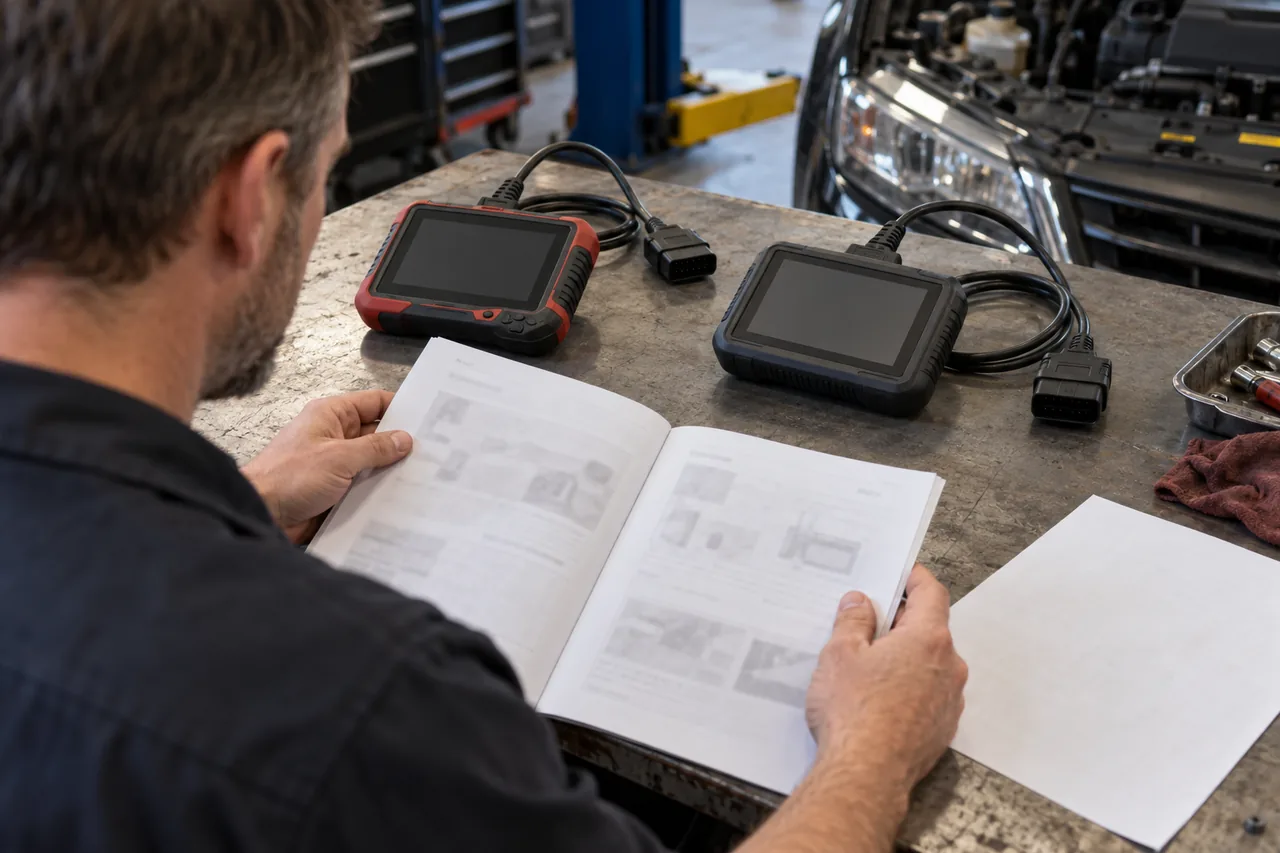
Imagine an AI-assisted draft comparing two diagnostic tools. It claims both support the same vehicle functions, although the supplied notes only describe one model. The editor removes that unsupported comparison, checks the available manufacturer material, and frames the article around questions buyers should verify for their vehicle. The team adds a clearly labeled hypothetical workshop scenario instead of pretending it tested the tools. This illustrates a review choice that improves honesty and usefulness without claiming any special ranking advantage for the edited page.
Frequently asked questions
Can an AI tool verify its own draft?
Use any generated review as a prompt for investigation, not final confirmation. A responsible editor should check meaningful claims against the actual sources and preserve the evidence behind the published wording.
Do we need to disclose imaginary examples?
Label hypothetical scenarios clearly so readers do not mistake them for customer results or personal tests. Avoid invented quotations and experience claims, even when they make a draft feel more persuasive.
About this guide
This guide presents an original planning framework and hypothetical examples. It does not report a product test or measured commercial result.
Program features, eligibility and terms can change. Check the official documentation before applying or promoting an offer. Examples in this guide are illustrative.
Put the next step into practice
Explore the free LinkRush campaign planner or continue learning below. Planning tools save your work in your browser.
Explore the workspace →